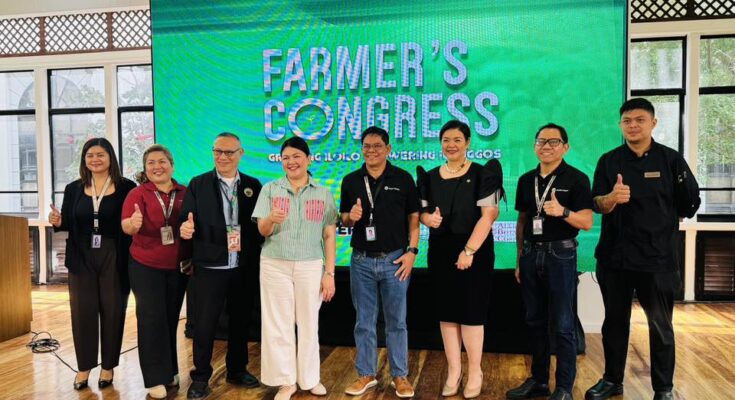
The Iloilo City Government, in partnership with MORE Power, convened its first-ever two-day Farmers Congress on February 26–27 at Kerr Building, bringing together urban farmers, brokers, sellers, hotels, restaurants, institutional buyers, and key public and private stakeholders in a landmark effort to strengthen Iloilo City’s farm-to-table ecosystem.
Organized through the Office of the City Agriculturist and supported by MORE Power, the Congress marked a significant step toward building stronger market linkages between local producers and the hospitality sector—transforming long-standing discussions on farm-to-table into concrete, operational strategies.
From Aspiration to Implementation
In his address, Iloilo City Agriculturist Iñigo Garingalao stressed that while the farm-to-table concept has long been promoted, the real challenge lies in addressing day-to-day operational realities.
Hotels and restaurants raised practical concerns: product quality, consistency, continuous and reliable supply, complete procurement documentation, and clear and workable payment schemes.
On the other hand, farmers and sellers outlined their own constraints—production planning aligned with demand, post-harvest handling, seasonality, access to storage, pricing stability, and navigating institutional purchasing systems.
“This Congress recognizes that solutions begin by hearing each side clearly and respectfully,” Garingalao emphasized, noting that honest dialogue between buyers and producers is essential to clarifying expectations, identifying responsibilities, and resolving bottlenecks.
Aligned with the direction of the Department of Agriculture to promote local procurement and stronger market access for farmers, and reinforced by Iloilo City’s push to make local produce more accessible through local market initiatives, the Congress aims to move from aspiration to implementation.
Rather than attempting to solve all issues at once, the initiative focuses on developing practical, Iloilo City–specific systems—even on a small scale. Proposed steps include piloting partnerships between select farmer groups and participating hotels; agreeing on quality specifications and delivery schedules; aligning crop planning with projected menu demands; standardizing documentation; ensuring transparent and mutually agreed payment timelines; and providing small-scale logistics and storage support.
Through manageable and measurable pilot efforts, stakeholders can test systems, build trust, and scale up successful models.

Farmers at the Heart of the City’s Growth
In her message, Iloilo City Mayor Raisa Treñas underscored that farmers are “very close to her heart.”
Upon assuming office, she directed the City Agriculturist to identify opportunities to grow and empower local farmers, recognizing that Iloilo City’s rapid urbanization must not leave the agricultural sector behind.
“We cannot stay the same because we are a highly urbanized city and many investors are coming in. We have to incorporate modern technology to increase production of farmers,” she said.

To address the lack of accessible selling spaces, Treñas launched the Merkado Lokal initiative, initially held once a month at the back of City Hall. Due to positive response, it now runs twice a month—providing farmers with a consistent platform to directly sell their produce.
She further vowed to open talipapas in each relocation site across the city and to allocate space for farmers in all public markets.
“Kada asosasyon ma-awardan naton stalls para makabaligya ang farmers sa tanan nga merkado sang syudad,” she said.
For the first time, farmers also began receiving financial assistance during disasters under her administration—acknowledging their vulnerability and vital role in ensuring food supply.
The city has expanded its urban farmlands from 170 hectares to 250 hectares, reinforcing its commitment to sustainable agriculture and food security.
“Part of our development is sustainable farming and food security. If we can produce our own need and not rely on outside sources, we can help in lowering prices of vegetables and rice,” the mayor added.
MORE Power’s Enduring Commitment
MORE Power Chief Operations Officer Paul Almedilla highlighted the company’s continuing partnership with Iloilo City farmers.
The company initially supported farmers by donating seeds and providing tents in Molo where they could sell their produce. The Farmers Congress, he said, reflects a deeper and more enduring commitment.
“This Congress is a powerful proof of our genuine concern for Iloilo City farmers and our enduring commitment to this vital partnership with the Iloilo City Government,” Almedilla said.
He expressed hope that the strengthened collaboration would build stronger farm-to-table linkages and contribute to Iloilo City’s distinction as a UNESCO Creative City of Gastronomy—honoring local agricultural heritage while reinforcing community development and food security.
Building an Inclusive Gastronomic Future
Promoting produce grown within Iloilo City strengthens its gastronomic journey—reducing travel time, minimizing the need for preservatives, lowering environmental impact, and ensuring fresher ingredients on hotel and restaurant menus.
More importantly, it makes economic growth more inclusive by positioning farmers as active partners in the city’s development.
As the two-day Congress unfolds, stakeholders aim to conclude with clear commitments, defined actions, and shared directions—ensuring that even small deliveries can create meaningful progress for Iloilo City.
Through dialogue, pilot programs, and sustained collaboration, the first-ever Farmers Congress signals a decisive step toward a more resilient, inclusive, and locally grounded food system for the city.