The continuing thin power supply in the Visayas has affected electricity rates across distribution utilities in the region, prompting the National Grid Corporation of the Philippines (NGCP) to place the grid under several yellow alerts since May.
In Iloilo City, MORE Electric and Power Corporation said it is hoping that power supply in the Visayas Grid will return to normal as soon as possible so that electricity rates may also go down.
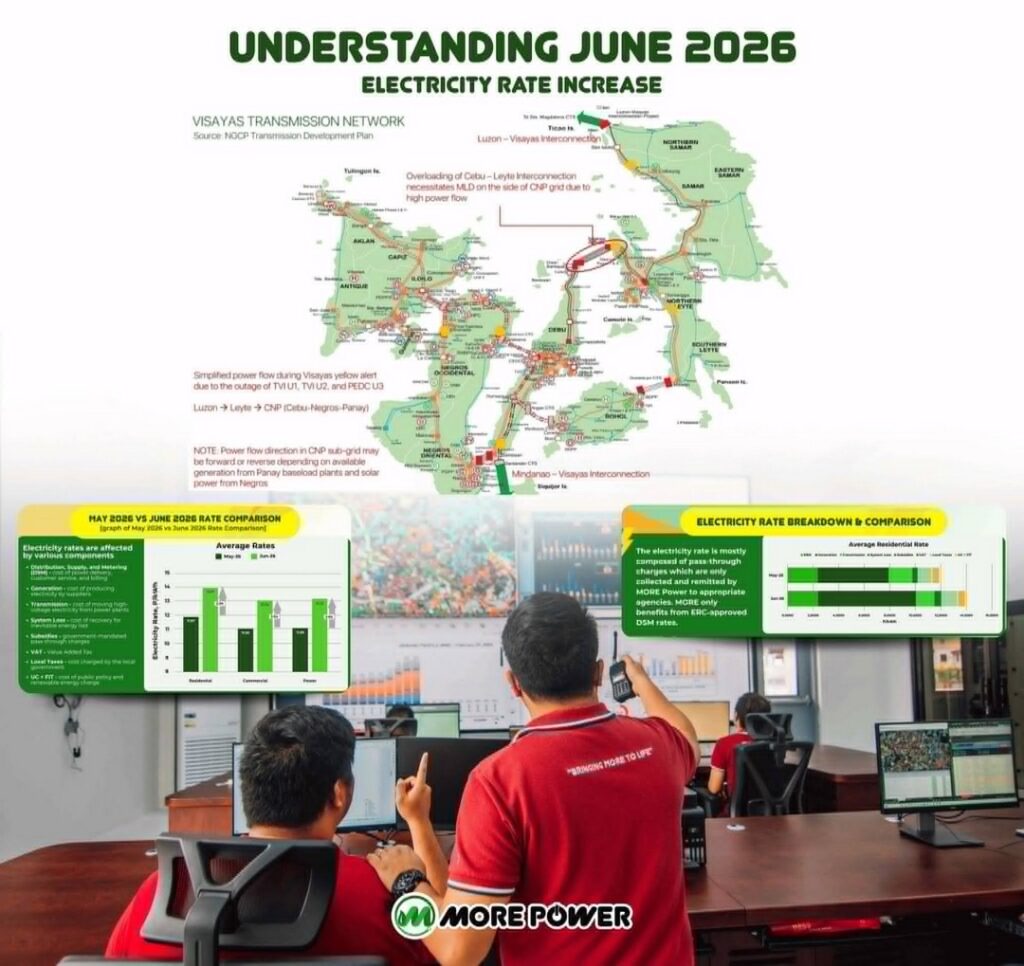
A yellow alert means available supply is not enough to meet demand, which may lead distribution utilities to implement manual load dropping or rotational power interruptions.
Based on the latest data, MORE Power recorded around 428,308.60 kWh in power losses from May 13 to June, affecting 177,727 consumers.
NGCP said the tight supply situation in the Visayas was caused by the outage of three major coal-fired power plants: Units 1 and 2 of Aboitiz Power Therma Visayas Inc., which have a capacity of 169 MW each, and Panay Energy Development Corporation (PEDC) Unit 3, which has a capacity of 150 MW. In total, about 488 MW remains unavailable from these plants.
As of June 23, NGCP data showed that 16 power plants were on forced outage, while 14 others were operating only at derated capacity. Altogether, 1,073 MW of power was unavailable.
Aside from generation issues, transmission constraints have also limited the amount of power reaching the Visayas grid despite supply coming from Luzon. NGCP said the Leyte-Cebu interconnection has limited capacity to support the Cebu-Negros-Panay grid.
“Nagapangabay kita nga tani earlier ang ila pagbalik sa grid para at least ma-stabilize man ang presyo sang kuryente diri sa aton sa Visayas Grid. Isa ini sa nakita naton nga big development kun tani para sa kaayuhan sang mga distribution utility kag mismo para sa mga konsumidor ilabi na nga ginapaabot ang El Niño ukon tuman kainit sang panahon nga mangin rason sa posible liwat nga pagtaas sang konsumo sang kuryente”, says Raphael Dorilag, Manager of Energy Sourcing Department of MORE Power.
The tight supply has also pushed prices higher in the electricity spot market or WESM. From ₱4.45 per kWh, prices climbed to ₱10.30 per kWh, while the generation rate rose by ₱2.10 per kWh to the current ₱7.735 per kWh.
MORE Power said it continues to look for cheaper power sources for its consumers by buying supply from bilateral suppliers whenever these are more affordable than WESM prices.
At present, 62% of its power supply is sourced through bilateral contracts, while 38% is purchased from WESM.
MORE Power also set aside paying in staggered tranches to its suppliers to avoid bill shock for its consumers in the succeeding months.
Wala sang pagbag-o sa presyo sang aton mga distribution charge sa MORE Power. Ginapabalo man naton nga inclusive na sang tax ang tanan naton nga rates rason nga transparent kita kag wala sang hidden charges sa mga bill nga galab-ot sa tagsa ka mga konsumidor”, says Dorilag.
MORE Power likewise advised consumers to be more careful and responsible in their electricity use amid continuing challenges in power generation and transmission.