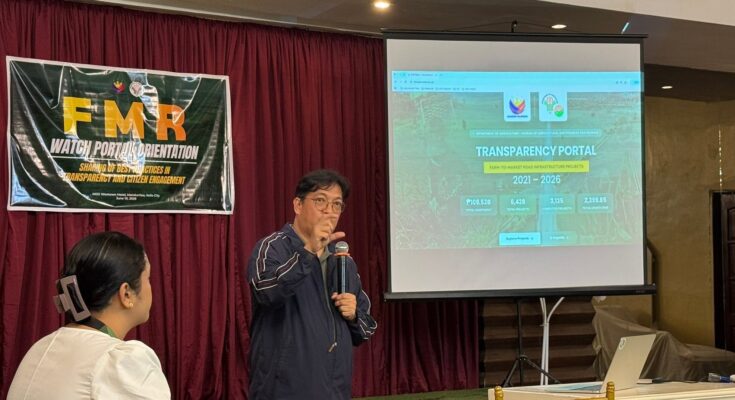
The Department of Agriculture (DA) Western Visayas, through the Bureau of Agricultural and Fisheries Engineering (BAFE), conducted the FMR Watch Portal Orientation on June 10 at MO2 Westown Hotel in Mandurriao, Iloilo City, highlighting efforts to promote transparency, accountability, and citizen engagement in Farm-to-Market Road (FMR) projects nationwide.
Welcoming participants were DA Western Visayas Regional Information Officer James Earl E. Ogatis, who underscored the importance of transparent and effective implementation of agricultural infrastructure projects.
A key highlight of the activity was the presentation of the FMR Watch Portal by Engr. Arnel Tenorio, Interim Chief of the Information Systems and Digitalization Division of BAFE. The portal serves as a transparency and monitoring platform that enables stakeholders to track Farm-to-Market Road projects from proposal to completion.
Among its features are project profiles containing budget allocations, locations, procurement status, program of works, implementation milestones, geotagged photos, and citizen feedback. The platform also includes mapping features that show the agricultural commodities supported by each road project, allowing users to better understand their impact on farming communities.
According to data available on the portal, 3,135 Farm-to-Market Road projects were completed nationwide from 2021 to 2025, representing a 67% completion rate. The portal also lists 817 projects that have yet to start and 34 deferred projects, providing the public with a clearer view of the status of government-funded agricultural infrastructure projects.
Following the portal presentation, Engr. Joyce Jamlang, Engineer II of the Special Engineering Programs and Projects Division of DA-BAFE, discussed the implementing guidelines governing Farm-to-Market Road projects, providing participants with an overview of the policies, standards, and requirements that guide FMR development across the country.
Project records in the FMR Watch Portal are synchronized from the Agricultural and Biosystems Engineering Management Information System (ABEMIS) and enriched with monitoring inputs such as project milestones, geotagged photos, and citizen feedback. Partner agencies and local government units may coordinate with BAFE to onboard projects, establish reporting schedules, and enable local validation workflows.
The orientation also featured a presentation on best practices in transparency and citizen engagement by representatives of the Philippine Rural Development Project (PRDP), emphasizing the role of public participation and digital monitoring in ensuring that infrastructure investments deliver meaningful benefits to farmers and rural communities.